What Is the Prime Minister Laptop Scheme?
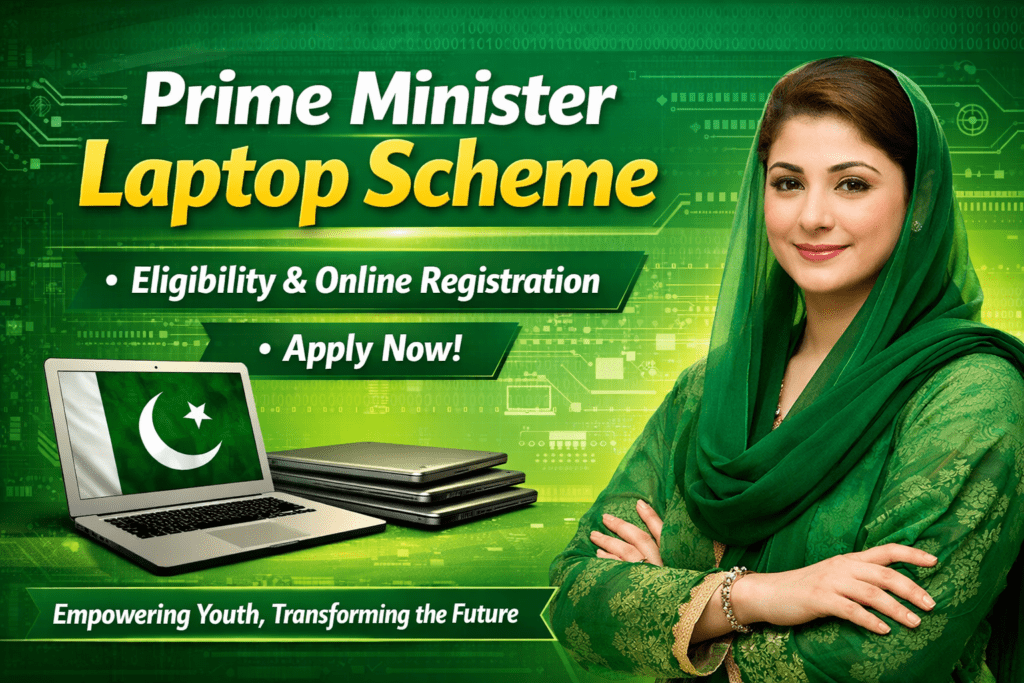
The Prime Minister Laptop Scheme is one of Pakistan’s most celebrated youth-focused initiatives, designed to bridge the digital divide and empower talented students studying in public sector universities across the country. Officially known as the Prime Minister’s Youth Laptop Scheme (PMYLS), this program falls under the broader umbrella of the Prime Minister’s Youth Programme (PMYP) and is executed with the support of the Higher Education Commission (HEC) of Pakistan.
At its core, the scheme revolves around a simple but powerful idea — that no deserving student should fall behind in the digital era simply because they lack access to a laptop. By providing free, high-quality laptops to merit-based students, the government aims to accelerate technology adoption in the academic sector and prepare the country’s youth for a competitive global landscape.
A Brief History of the Prime Minister Laptop Scheme
Phase I and Phase II — Building the Foundation
The Prime Minister Laptop Scheme did not arrive overnight. It was introduced in earlier phases under a similar title — the PM National Laptop Scheme (PMNLS) — where Phase I and Phase II were successfully executed by the Higher Education Commission. During Phase II alone, approximately 500,000 laptops were distributed through a transparent online system across public sector universities, technical colleges, Federal institutions, and FATA colleges. Information about the entire process was kept publicly available on the HEC website to maintain complete transparency.
Phase III — Scaling Up the Mission
Building on the success of previous phases, the Prime Minister announced Phase III of the scheme, which was officially approved by ECNEC. Under this phase, 100,000 laptops were to be awarded to talented and deserving students strictly on merit through an online, transparent system. The focus remained consistent — identify students who demonstrate academic excellence and reward them with a tool that can define their future.
Phase IV — Continuing Into 2025 and Beyond
The latest chapter of the Prime Minister Laptop Scheme is Phase IV, which has been actively rolling out in 2025. Multiple universities have already begun document verification processes, and formal distribution ceremonies have been initiated at institutions such as the Islamia University of Bahawalpur, where laptop distribution commenced in February 2026. This reflects the scheme’s ongoing nature and the government’s sustained commitment to youth empowerment.
Why the Prime Minister Laptop Scheme Matters
Pakistan has a unique demographic advantage — nearly 63% of its population is under the age of 30. This youthful energy is both a tremendous opportunity and a challenge. If invested in wisely, this generation could be the engine of national progress. If neglected, it risks becoming a burden.
The Prime Minister Laptop Scheme directly addresses this concern by providing youth with access to Information and Communication Technologies (ICTs). Laptops are not just devices; they are gateways to research, online learning, freelancing, digital networking, and career development. When a student in a public university receives a laptop through this scheme, they gain the ability to compete on equal footing with peers across the world.
The scheme also plays a vital role in improving the quality of science and technology education, developing stronger partnerships between academic institutions and industries, and enabling smart campus environments that support better learning and instant networking.
Eligibility Criteria for the Prime Minister Laptop Scheme
Who Is Eligible?
The Prime Minister Laptop Scheme follows a well-defined eligibility framework. Students who meet the following criteria are generally considered eligible:
Students studying in public sector universities and degree-awarding institutions recognized by HEC are the primary candidates. Those enrolled in programs ranging from undergraduate to PhD, MS, or MPhil programs (18-year education system) are included.
Who Is Not Eligible?
The scheme maintains clear boundaries to ensure fair distribution. Students enrolled in private sector higher education institutions are not eligible. Similarly, students at government degree and postgraduate colleges or affiliated colleges fall outside the scope of this particular scheme. Those who have already received a laptop under any federal or provincial government initiative are also excluded. Students who fail to apply through the official online portal within the given deadline, or who cannot produce the required academic documents at the time of distribution, are disqualified as well. Any student who completes their degree program before the laptop is distributed also loses their eligibility.
How Does the Prime Minister Laptop Scheme Work?
The Application Process
Applying for the Prime Minister Laptop Scheme is a fully digital process. Students are required to register or update their profiles on the HEC Students’ Service Portal at the official website. A dedicated mobile app, available on both Google Play and the Apple App Store, also makes the application process accessible to students across all regions.
Students who have previously applied must use the “Update” section to reapply rather than creating a new application, as duplicate entries can cause complications during the verification phase.
Merit List Generation and Verification
Once the application deadline passes, an automated system generates a provisional merit list for each university based on the predefined quota and academic performance data. Each institute receives its share of laptops according to the quota allocated by HEC.
Universities then cross-check the provisional merit list and submit corrections within 15 days. After all discrepancies are resolved, the final merit list is published — both on the official portal and on the university’s notice board, website, or social media pages — so that every student and member of the general public can verify results in a completely open manner.
Document Verification and Distribution
Before receiving their laptops, selected students must present original documents, including their CNIC, student ID, enrollment proof, and academic transcripts. Eligibility is re-verified at the time of distribution, meaning students whose academic status has changed may not receive a device even if their name appears on the merit list. Universities assign focal persons to assist students throughout the process and address any issues that arise.
The Broader Impact of the Prime Minister Laptop Scheme
Empowering Pakistan’s Digital Generation
The long-term vision behind the Prime Minister Laptop Scheme goes far beyond distributing hardware. It is about creating a generation of digitally literate citizens who can contribute to Pakistan’s knowledge economy. By equipping students with laptops, the government is investing in research capabilities, freelancing potential, and the overall competitiveness of Pakistan’s workforce on a global scale.
Bridging the Digital Divide
One of the most meaningful outcomes of the scheme is how it levels the playing field. Students from smaller cities, rural backgrounds, and lower-income families who study in public universities now have access to the same academic tools as their more privileged peers. This kind of equitable access is foundational to building a fair and forward-looking society.
Supporting Academic Excellence
Faculty members and university administrators across Pakistan have noted that students who receive laptops through the Prime Minister Laptop Scheme tend to perform better in research-heavy courses, digital assignments, and remote learning environments. A laptop is not just a luxury — in today’s academic landscape, it is an essential academic instrument.
How to Check Your Status and Stay Updated
Students who have already applied for the Prime Minister Laptop Scheme should regularly visit the official PMYP portal at laptop.pmyp.gov.pk and the HEC website to stay updated on their application status, merit list announcements, and distribution schedules. Those who missed the 2025 application window are encouraged to stay connected with their university’s designated focal person and prepare documents in advance for the next phase when it opens.
Final Thoughts on the Prime Minister Laptop Scheme
The Prime Minister Laptop Scheme stands as a shining example of how targeted government investment in youth can yield widespread social and economic benefits. From Phase I to the ongoing Phase IV, the program has successfully distributed hundreds of thousands of laptops to deserving students and continues to expand its reach.
For students currently enrolled in public sector universities across Pakistan, this scheme represents more than just free technology — it represents an opportunity, a vote of confidence, and a tangible step toward a brighter, more connected future.